Thursday, March 1, 2012

The Big Review: Salmon Fishing in the Yemen

Before my brother and I moved away, we would occasionally visit my grandmother and bring a movie to watch on her VCR. The movies had to be pleasant because she pretty much stopped following movies after "Oklahoma!"

Consequently, it was hard to find stuff that the three of us could enjoy. I remember watching "The American President" and "Sleepless in Seattle." Watching "Salmon Fishing in the Yemen," I couldn't help but think, "She would have really liked this."

"Salmon Fishing in the Yemen" is the perfect "Grandma movie," and I mean that as a compliment.

As for my other grandmother, Grammy Dot, she watched everything. In Florida, Gram and her pals Sal and Rose would sneak into the movies. She adored Bruce Willis, and enjoyed the "Die Hard" movies. And I remember her getting all schoolgirl giggly recalling Bruce Dern's bare ass in "Coming Home."

Wow, I miss my grandparents.

This review previously appeared in "ICON" and is reprinted with permission. (Thanks, Trina.)


**************

This year the multiplex offered two releases timed for Valentine's Day: The Vow, a scented candle of a movie with The Notebook's stale aroma, and This Means War, an adrenaline-laced romance from the auteur behind Charlie's Angels that for some reason starred Reese Witherspoon. (I did not see the second movie. Witherspoon's confused expression in the previews struck me as a dire warning.)

The more adult date movies, stuff like An Officer and a Gentleman or Out of Sight, are hard to find these days. As Mark Harris lamented in his brilliant essay for GQ, "The Day the Movies Died," a trip to the neighborhood movie house once meant that "adults were treated as adults rather than as overgrown children hell-bent on enshrining their own arrested development." Grown-up crowd pleasers have been shelved for can't-miss, profit-generating products aimed at shiny new things. Which would explain why Witherspoon, who turns 36 in March, still chases the youth vote.

Those factors have contributed to Salmon Fishing in the Yemen, an adaptation of Paul Torday's novel, opening in the anonymous month of March. The movie is a throwback in the best possible way, featuring adults with problems that can't be solved by special effects or wardrobe changes. Directed with uncharacteristic restraint by Lasse Hallström, who ripped out our heartstrings with Chocolat and The Cider House Rules, his latest film surprises us with its lack of saccharine guile.

Events begin when young consultant Harriet Chetwode-Talbot (Emily Blunt) reaches out to Dr. Alfred Jones (Ewan McGregor), Britain's fisheries expert, on behalf of her wealthy client, a sheikh who wants to introduce salmon fishing to Yemen. Harriet believes this will improve "Anglo-Yemeni relations." Alfred immediately dismisses the project as "fundamentally unfeasible."

That would be that, except violence in the Middle East has the British prime minister's publicity maven (Kristin Scott Thomas) searching for good news there that she can attach to the UK. She finds Harriet's email regarding the salmon project and puts it on the fast track. Alfred, the embodiment of the stuffed-shirt academic, hates the idea. The sheikh’s plan is a waste of time, nothing more than the extravagant whims of a deluded, well-funded hobbyist. Harriet, of course, disagrees, backing up her points with science and hard data. Pressure from work and at home, plus the promise of a big salary, forces Alfred to collaborate with Harriet on the fishing equivalent of a mission to Mars.

A funny thing happens. Alfred becomes fascinated by the project's ambition and the ideals of the kind sheikh (Amr Waked), who views fishing as a religion that's open to all. But it's Harriet, whip-smart and PR pretty, who energizes him. Clearly the two are destined to share a toothbrush, so Hallström and Simon Beaufoy (the wry, heartfelt screenwriter of The Full Monty and Slumdog Millionaire) concentrate on their growing rapport. The delivery is surprisingly uncutesy, like the scene where Alfred corrects Harriet (who guessed his measurements) on his pants size when they both look terrific in formal attire or how he brings her a sandwich during a rough patch. His attraction to her goes beyond the physical. "She's a friend," Alfred screams at his suspicious, emotionally distant wife (Rachael Stirling). Harriet's professional façade hides a scared kid; Alfred's kindness is a balm to her. Right before Harriet and her new solider boyfriend (Tom Mison) make love, she tells him to "please be nice to me." Alfred and Harriet are proficient in everything else, except as people in relationships. They need each other, especially since their current partners are concepts. Harriet barely knows her boyfriend, but the newness excites her. Alfred's wife, constantly traveling for her job, has become a co-worker he sometimes shares a bed with.

The selling point behind any romance is its leads—they must resemble us in some way. Harriet's premature swooning and Alfred's complancey fit the bill, but Blunt and McGregor's ability to evolve throughout the movie instead of offering one trademark emotion is crucial. (That's one reason why The Vow, starring the permanently dour Rachel McAdams and Channing Tatum—whose defining characteristic is his apparent devotion to ab workouts—so ponderous.) Blunt and McGregor soften throughout the movie, and we follow suit. When things get too mushy, Scott Thomas, channeling Peter Capaldi's profane spin doctor from In the Loop, offers a riotous, curt complement.

Salmon Fishing in the Yemen charms us slowly and assuredly, offering us a sparkling romance in real-life terms. Harriet learns that you can't fall in love with an idea. Alfred discovers that a soul mate compels you to exceed your own expectations. Hallström does nothing more than reveal that there is a fish for every line, an idea that may not be sexy enough for big box-office. But for an enchanting, relatable romantic comedy, it's pretty close to perfect. [PG-13]

Wednesday, February 29, 2012

Review of "Wanderlust"

The film occasionally goes off the rails, but I enjoyed it. Rudd and Aniston are quite good. You can read the review, which appeared in "The Weekender", right here.

I'm writing this while battling a colossal cold, which does have an advantage: I finally get to live out the lyrics to Guns N' Roses "Mr. Brownstone."

Be back soon with more goodies. Toodles!

Wednesday, February 15, 2012

Review of "The Vow"

The review, which appeared in "The Weekender" is here. If your checklist for a good movie includes Channing Tatum's ass, then you're in luck. Everyone else should rent "The Notebook" again, which "The Vow" desperately emulates.

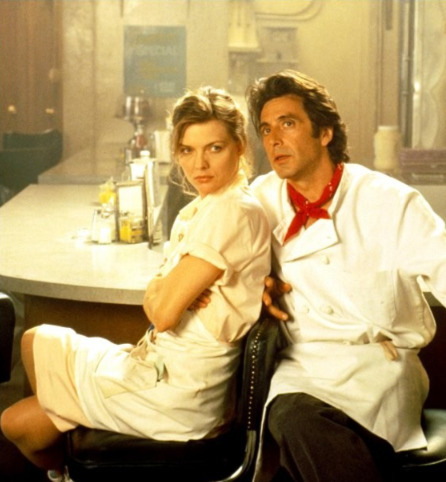
Or track down 1991's "Frankie & Johnny" (pictured). It's a working-class romance starring Michelle Pfeiffer and Al Pacino as co-workers at a New York coffee shop; he's optimistic and well-read, she's a world-weary high school drop out. It's a love story about real people with real issues who approach a promising relationship from two different but potentially destructive mindsets. Pacino, before he became whatever he is, and Pfeiffer are terrific. You know who directed it? Garry Marshall, who at one point made movies that were not adapted from greeting cards.

What are some other good date night movies that men and women should like. Here are 10 quick selections from multiple decades:

1.) "An Officer and a Gentleman"
2.) "Out of Sight"
3.) "The American President"
4.) "Love Actually"
5.) "Forgetting Sarah Marshall"
6.) "Bringing Up Baby"
7.) "Annie Hall"
8.) "Some Like it Hot"
9.) "Roman Holiday" (even though Gregory Peck's formal delivery nearly ruins it)
10.)"Casablanca"

And then there's a lovely movie slated for release next month that is a solid option. I'll talk more about that in March.

Monday, February 13, 2012

Book of the Month, February 2012

I love books. They're fun, educational, and they were the subject of one of the best episodes of "The Twilight Zone" ever. Remember, always pack your spare reading glasses. Or wear contacts.

This is quite embarrassing, but it's been a while since I've actually had a movie-related book up here. Well, recently, I read one: Brian Kellow's wonderful biography of Pauline Kael subtitled "A Life in the Dark."

For those who don't know, Kael (1919-2001) was the influential, venerable film critic for "The New Yorker" for over 25 years. It's hard to explain Kael's impact without stumbling into hyperbole, but her influence can be traced to her friends and disciples: Carrie Rickey, David Denby, Owen Gleiberman, and Armond White to name a few. Ebert has cited her as his hero. Kellow, a longtime fan, celebrates what made Kael the queen bee of film criticism: her intellectual tenacity, her refusal to compromise her style (she gave "New Yorker" editor William Shawn constant aggravation), and her intimate, nimble writing style (on gorgeous display here).

But the mark of any good biography is when an author examines the whole life, and Kellow doesn't shy away from Kael's ugly side. Rickey and Gleiberman both had fallings out with her partly becausee they were not full-blown sycophants. Kael relied on her daughter, Gina James, to the point that many observers felt Gina never became her own woman. Some thought Kael was too friendly with directors like Robert Altman and Brian DePalma. Others hated her tendency to use superlatives, which made her sound like she was gunning for movie posters. And then there was her disastrous stint as a script reader for Warren Beatty, who may have charmed her away (briefly) from "The New Yorker."

The result is a compulsively readable biography on a woman whose talents kept her aloft professionally but made her all too human. It's a terrific book, and it's made me eager to explore Kellow's other works.

That's all for now. Until next month, read in peace.

Monday, February 6, 2012

Why the Hell Did I Watch...Old Dogs?

What happens when two former box-office behemoths refuse to transition into the able supporting actor phase of their careers, and insist that their tired, endlessly peddled charisma can conquer all?

Thursday, February 2, 2012

Film Round-Up for Feb. 2012: The Innkeepers, Albert Nobbs, Perfect Sense, The Grey

When the best movie here is about a pack of roughnecks being chased by wild wolves, you know you're in for a rough month. I will say that one of the pleasures this month was recognizing what an expressive, vivacious presence Eva Green is.

The reviews appeared in the February issue of ICON and are reprinted with permission. (Thanks, Trina.)


*************************************

The Innkeepers (Dir: Ti West). Starring: Sara Paxton, Pat Healy, Kelly McGillis. It's the last weekend for the Yankee Pedlar Inn, a creaky New England hotel that has fallen into disrepair and irrelevancy. The owner is long gone, leaving staff members Claire (Paxton) and Luke (Healy) to close up shop and pursue other interests, namely observing the building's celebrated paranormal activity. What starts as a nighttime lark soon turns into something far more dangerous as Claire uncovers sights far more dangerous than things that go bump in the night. West's script establishes a sarcastic rapport between Claire and Luke, two young adults now starting to realize how much potential they've wasted. Aside from that refreshing maneuver, The Innkeepers is a straightforward, contemporary haunted house (or rather hotel) tale that offers some scares amidst the indie-flavored substance. West, who also edited and produced the film, is a Wilmington, DE native. And yes, that's '80s leading lady McGillis of Witness and Top Gun fame as a hotel guest with hidden motives. [R] **

Perfect Sense (Dir: David Mackenzie). Starring: Ewan McGregor, Eva Green, Connie Nielsen, Ewen Bremner, Stephen Dillane. A bike-riding, womanizing chef (McGregor) and a self-centered, intense epidemiologist (Green, Casino Royale) take a fancy to each other in modern-day Belfast. Their burgeoning relationship occurs amidst a worldwide catastrophe: people are mysteriously losing their senses, leading to a scary, uncertain future. The movie's best assets are McGregor and Green, who make us care about two narcissistic souls learning to love in a time of catastrophe. The actors also elevate the film above apocalyptic gimmickry. In these times of social, environmental, and geo-political uncertainty, directors and writers have repeatedly gone the world-is-coming-undone route. Sometimes it works. Here, Mackenzie (Mister Foe) nearly breaks his arms in his forceful embrace of that perspective. He has Green deliver a somber, pretentious narration and eagerly presents people freaking out a la The Happening, leading to scenes that are more amusing than arresting. Perfect Sense proves that some stories are best served straight up. Also available On Demand. [NR] **

Albert Nobbs (Dir: Rodrigo Garcia). Starring: Glenn Close, Janet McTeer, Mia Wasikowska, Aaron Johnson, Brendan Gleeson, Brenda Fricker, Pauline Collins. Close, in the title role, portrays a woman who disguises herself as a man in 1890s Ireland. Nobbs' life as a hotel waiter is all stoic professionalism until she meets a fellow gender disguiser (McTeer), who proves that the good life (i.e., house, wife, business) is attainable. Inspired and flush with cash, Nobbs sets her socially awkward sights on a beautiful, uninterested coworker (Wasikowska), a pursuit that guarantees heartbreak. Terrific cast and a promising concept can't overcome the fact that Nobbs is—forgive the lack of poetry here—boring. She's mopey and meek, and her humanity remains disguised during the entire film. That's your central protagonist, folks. And she's featured in a plot with zero drama, thanks to a script crammed with clichéd supporting characters (daft elderly waiters, gossipy kitchen help, hard-drinking doctors), each one painted in the same shade of bland. All take away from Nobbs' internal struggle, which is never clearly defined. Close also served as a producer and writer. [R] **

The Grey (Dir: Joe Carnahan). Starring: Liam Neeson, James Badge Dale, Frank Grillo, Dermot Mulroney, Dallas Roberts, Nonso Anozie, Joe Anderson. A plane carrying a ragtag group of oil drillers crashes into the snowy Alaskan unknown, leaving seven survivors with limited provisions and no chance of being found. If that doesn’t qualify as bad luck, there's this: The men's unscheduled destination is home to a pack of vicious wolves that doesn't appreciate outsiders. Ottway (Neeson), the stoic sniper who picks off these predators on the drilling sites, becomes the leader of these ornery men. His plan is to have them reach the forest—and possible safety—before the wolves get them. Carnahan's jumpy, gritty approach fits well with the hunter vs. hunted storyline, and he slows the movie down so we see the humanity behind this scruffy pack of misfits. The Grey is the latest installment in Neeson's quest to become the symbol of senior, self-tortured virility. The plan is working. Neeson brings the macho in this entertaining outing that lets your mind drift while keeping your eyes open. [R] ***

The Big Review: Extremely Loud and Incredibly Close

I wrote a shorter review for "The Weekender," but for those who like their hatred with a higher word count, here you go.

I know there were complaints a year or so ago when the Associated Press limited its movie reviews to 600 words. Part of me sees the harm in this, as it does cut down on the riffs and asides that provide color to reviews, which differntiates a review of a movie from a zoning board meeting recap. Another part of me thinks there's no problem with this. Do we really need 1,500 words on "The Grey"? Or even 800?

If the writing is crisp and expressive and full of good ideas, word count is irrelevant. Trina McKenna of "ICON", where this review originally was published and is being reprinted with permission, gives me cart blanche in terms of space. It's a dream situation, but it's also an excellent breeding ground to become a pompous ass.

I ain't there yet, thank God. So enjoy the review, and avoid the movie.


*********************************

You know what Extremely Loud & Incredibly Close needs? Wes Anderson. In his best work The Royal Tenenbaums' director creates his own little retro world, giving us enough clues to assure us not to take everything so seriously, and filling it with characters whose flaws we embrace. Stephen Daldry cannot do that. His Extremely Loud & Incredibly Close is intellectually precious and dripping with stylistic hiccups. It needs a director who detests the ordinary, who embraces the grand. Daldry directs as if quirk, like tension or romance, is part of every film lover's language. It is not.

For a movie rushed to theaters so it could be eligible for Oscar nominations, Daldry's approach is expected. (Note: I'm writing this two days before nominations are announced. If Extremely Loud & Incredibly Close gets any, we should all start preparing for that Mayan apocalypse.) Everything that distinguishes Extremely Loud & Incredibly Close, however, is flagrantly, almost aggressively, negative: its lack of ambition, its condescending attitude, and its unpleasantness. The last trait is astounding since the movie includes Tom Hanks and Sandra Bullock, two actors who have built their legends by being more benign than anybody else.

The superstars, whose screen time is limited, are not the irritants. The actor who gets the limelight is 14-year-old newcomer and former Jeopardy! champ, Thomas Horn. He plays Oskar Schell, an 11-year-old who enjoys a special relationship with his father, Thomas (Hanks). The old man creates elaborate hunts—or "reconnaissance expeditions"—for his shy, awkward son, many of which involve talking to strangers. As part of their twee rapport, father and son also commiserate over maps in ice cream parlors and stage oxymoron battles. Mom (Bullock) lurks in the background, showing little concern that her son is talking to New York City derelicts and demonstrating the snobby attitude of a Starbucks barista forever five credits short of their philosophy Ph.D.

Life is beautiful until September 11, 2001, when Oskar's dad dies in the World Trade Center attacks. A year passes. Oskar's memories start to fade, causing him to venture into Dad's bedroom closet, where a vase tumbles from a shelf. The clues quickly mount: A small envelope, "Black" neatly printed on it, which contains a key. A newspaper clipping in Thomas' pocket that has the words "not stop looking" circled. The boy is convinced that his father wants him to find something. Equipped with an organizational scheme inspired by a John Hodgman diagram, Oskar starts visiting every Black listed in the five boroughs' phone books.

Such an investigation isn't easy for Oskar, who is scared of everything around him, including bridges and people with bad teeth. The audience is also in for a rough trip. Daldry stages his journey on real-life terms, which makes everything all the more preposterous: Max von Sydow, Oskar's voluntarily mute companion, displaying "yes" and "no" on the palms of his hands; the stylish photos of ordinary people taken by Oskar that resemble what Diane Arbus had taken if she favored Kodachrome; Oskar's book of his journey, which belongs in the window of a Park Slope stationery store. And is anyone else disturbed that a kid is roaming the five boroughs alone, even if mom is too grief-stricken to notice?

The world Oskar occupies needs to be bigger, wackier, something so we aren't constantly confronted with the burden of reality. (One reason why Super 8 and Hugo worked so well is because the films looked like storybooks.) Oskar, an eloquently verbose and tortured soul governed by his own pretzel logic, cannot exist in the real world. Under that enchanting spell of realism, Oskar's journey becomes dull. Magic can't bloom here. Neither does character development. Oskar may be clever and plucky, but he's also an impatient brat who, when not talking like a haughty boy robot, blurts out his fears. Horn delivers a corrosive performance, but I don't think he has much choice. Oskar is clearly a mess. He's fatherless, pinches himself to the point of bruising, and treats his elders like peons. He even admits that he was tested for Asperger's. But couldn't someone—Daldry, veteran screenwriter Eric Roth (who penned Forrest Gump, for crying out loud)—have found a way to make Oskar tolerable? The only way I would ever get behind Oskar is if I could push him off a cliff. A hero that engenders such spitting hatred has to violate every tenet of screenwriting.

Hanks and Bullock come and go, though in the film's final stretch Bullock's character proves that she's a good mother. The takeaway message for parents: indulge your kid's behavior no matter how dangerous or misguided. After all, kids are people who need to let go of grief in their own way. Really? The value of Extremely Loud & Incredibly Close, though it's unintentional, is that it reveals the true threat to this nation. It's not fear and uncertainty. It is the current generation of coddled, bratty, flash card-trained little monsters who never hear "no" from their parents. [PG-13]