Friday, June 28, 2013

Finding Gold in a River of Crap

Will French Stewart's star ever stop rising?
I'm woefully behind on posting my reviews for The Weekender, probably because the last few movies have been so dreadful and I don't want to relive the memories.

But, here are links to The Hangover Part III (page 23), The Internship (page 16), and World War Z.

Yup, another string of mainstream duds. Without getting into too much gory detail, the streak will continue with The Lone Ranger. So that means I haven't reviewed a halfway decent multiplex offering since G.I. Joe: Retaliation. That was in April. Wow.

Believe it or not, this is not the longest lull I've suffered. For a few years, my college friend Marie was a frequent movie partner. From like 1999 to 2002, the two of us saw pretty much nothing but shitty movies: Love Stinks, Eye of the Beholder, Moonlight Mile. There was a 95 percent chance if the two of us saw a movie, it wouldn't be certified fresh by Rotten Tomatoes.

These things happen from time to time. You see great movies. You see terrible movies. You see movies. But the nice part is that they can bring you back to a snippet of time. Just typing in those long-ago titles reminds me of the good times Marie and I--who are still friends--had.

A movie title can take you back to who you were and how far you've come. It's a pretty cool measurement of time.

Monday, June 17, 2013

Clearing up Myths and Misconceptions

Anybody on this line could be a critic.
A few weeks back, a couple of items found their way around the Internet that brought movie writers to a tizzy: MarketWatch's puddle-deep insight regarding what film critics won't tell you and Romina Puga's disastrous interview with Jesse Eisenberg during the Now You See Me press junket.

I'm not going to provide links, because a.) you can find them with a simple Google search; and b.) I don't want to devote more attention to such things.

(By the way, MarketWatch scribes, I've never used the phrase "limns alterity" nor would I read anyone who wrote such snobby garbage. In fact, if I ever use a phrase like that--or come close to attempting to do so--you have permission to introduce my head to a swinging aluminum bat.)

What I will do is provide some insight into what it's like being a movie critic and interviewing notable folks that will a.) be illuminating and b.) not make me look like a total knob. Here we go.

1.) We are moviegoers just like you. I cannot stress this enough. I've seen American Pie more times than any one Hitchcock movie. I can practically recite Rounders in my sleep. If you and I talked, you might be shocked by what I like. I'm not sitting in my bedroom reading Film Comment in my Pauline Kael footie pajamas while Citizen Kane plays for the 30th time that month.

Here's the key difference: I'm more willing to go diving for pearls than you. Somewhere along the line, watching movies became a pursuit for me rather than a hobby. (That's why top 10 lists look so funky and quaint.) You were different, and it's probably a good thing. Do you go through your life feeling like you're in perpetual debt because you haven't seen stuff like Upstream Color yet? I do, and it sucks hard.

2.) If we don't connect with the public, we need to pursue a plan B. It's my job, theoretically speaking, to make you feel what I felt while watching a movie. That involves using emotions and language and passion. That is not the work of an elitist or a crank. Read Roger Ebert's memoir and you'll understand why he was so good at his craft: He used movies as a way to write about the human experience. (In fact, the first sentence in this section is attributable to him. Man, I miss that guy.)

Ladies and gentlemen, Stubby Kaye!
3.) Being in the blurb business will crush our souls to dust. The moment you write to land on movie posters is the moment you become the advertising arm of the movie industry. Write how you feel, not because it will look good as part of the coming attraction. When your true self shines through, that's when people will care what you write about.

4.) We don't hate movies. Why would I, or anyone, pursue something that makes us miserable? (And, yes, I know the reviews for The Weekender have been scathing lately.) Especially when...

5.) We don't get paid nearly enough. Right now, what I make yearly from movie writing--an average of two reviews a week--wouldn't pay three months' rent. I love watching films and sharing my opinions about them. I get a buzz doing this that I don't get from writing about anything else, and writing is the great pleasure of my life.

6.) We don't see everything, because we have other interests--and other jobs. This is more of a royal we. As a freelance writer, I could have a dozen projects going on at any one time. I simply don't have the time to see everything. I wish I could, and I hope the reality changes, but this is the game for now. And, trust me, this is way better than it used to be.

Give our best to Morgy, will ya?
7.) Professionalism means everything. David Halberstam used to say that his name was his currency, and he was only a Pulitzer Prize winner and one of the finest journalists of the 20th century. That goes double for most of us, especially when it comes to interviews with directors and actors and screenwriters. So, there are some rules we must follow: Be prompt. Be professional. Have good, well-researched questions ready. Let the subject talk and talk. Listen. Don't joke unless you have a sense of the tone of the interview, and even then think twice before unleashing your spiffy comment. Do those things--while saying please and thank you--and everything else is cream cheese.

8.) There is no director, or film, whom we all drool over. Another person may love Tarantino, another may hate him. You loved Silver Linings Playbook; I wanted to stab the movie through the throat with my pen. That's the essence of film criticism: trying to convince someone to go on a funky adventure and embrace your logic. If we all followed the pack, then what would be the point?

9.) Twitter is great for us, but also the worst. My college pal James Brennan made a terrific point, that I'm probably garbling here: Twitter brings out the trolls who are so loud and annoying that open discourse is immediately shut off. I'm talking about gimmicks and flash and "thiz actor is worstest than AIDS" that spells doom for thoughtful writing.

But, man, oh man: the ability to have a platform to express ourselves, to get people to read something? The potential is amazing if we can get through the brush.

10.) Movies are not something we battle against. We're doing this because we can't wait for the next thrill. We don't know where it comes from or who will provide it. All we know is, we want to be there. And we want to be the first to tell you all about it.

Tuesday, June 4, 2013

Film Round-Up June 2013: Shadow Dancer, Triumph of the Wall, Frances Ha, The English Teacher

Greta Gerwig playing the girl we've all known--or will know.
OK, everyone: here's irrefutable proof that from time to time I enjoy things. These reviews originally appeared in the June issue of ICON and are reprinted with permission. 

*******************

Shadow Dancer (Dir: James Marsh). Starring: Andrea Riseborough, Clive Owen, Aidan Gillen, Domhnall Gleeson, Brid Brennan, David Wilmot, Gillian Anderson. Established documentarian Marsh (Man on Wire, Project Nim) nimbly directed this character-driven spy tale set in 1993, when tensions in Northern Ireland are starting to fade. After a failed bomb attempt in London, reluctant IRA participant and Belfast single mother Collette (Riseborough) is captured by MI5 and promised protection in return for information on her IRA headliner brothers (Gillen, Gleeson). Collette agrees, but the influence of her government contact (Owen) gradually erodes, placing her and her family at risk while he scrambles for answers. The twists and turns don’t hold our attention as much as the characters’ inability to go beyond their assigned roles. The movie’s color scheme is defined by dreary, optimism-draining browns and grays; Owen and Riseborough (who are excellent) look tired and withered. Subtle and introspective, Shadow Dancer shows the working-class grind behind the cloak and dagger excitement. The burden of real life affects everyone. Tom Bradby adapted the script from his novel. [R] ***

Triumph of the Wall (Dir: Bill Stone). Usually when someone tells you a movie, or anything for that matter, doubles as a “metaphor for life,” it’s a cue to roll your eyes. Here’s an exception, a low-key film with emotional heft. Filmmaker Stone meets Chris Overing, a laconic handyman who resembles Josh Duhamel, in a coffee shop. Overing is building a 1,000 ft. dry-stone wall in rural Quebec for a client’s property. The project, he estimates, will take eight weeks; Stone agrees to film it. Years later, Overing and a rotating door of assistants are still working on the damned wall, which has Stone approaching his film from a more philosophical perspective. One of the assistants, Paul, notes how you take a few days off from the wall only to return confused. But as Overing observes, even though the project is taking forever, he’s making something with inherent value. That’s why he keeps coming back, and why Stone keeps the camera rolling. Both men want to build something that lasts. We all do. [NR] *** ½

Frances Ha (Dir: Noah Baumbach). Starring: Greta Gerwig, Mickey Sumner, Michael Zegen, Adam Driver, Patrick Heusinger. “I’m not a real person yet,” says the film’s title character (Gerwig), a young New Yorker whose life is in perpetual almost. She not quite in a relationship with a burgeoning alcoholic before they (kind of) break up. She’s an apprentice at a modern dance company. Her friendship with Sophie (Sumner) would qualify as a marriage if they weren’t interested in men. When life starts changing–Sophie moves on, money dries up–Frances finds herself slipping into the twentysomething mire: she’s too old to be an artsy ingénue but too young to settle for what isn’t her ideal. Baumbach, shrewdly avoiding an indictment on entitled Generation Yers, illuminates the awkwardness of transitioning from young adult to adult. It’s Gerwig who breathes heart and soul into that concept, delivering an effervescent, guileless performance as a young woman finding her place at the adult table. (Literally. When she asks a dinner guest what he does for a living, it sounds like she’s play-acting.) Gerwig and Baumbach, who both wrote the acridly funny script, create a character we love—for better or for worse. [R] ****
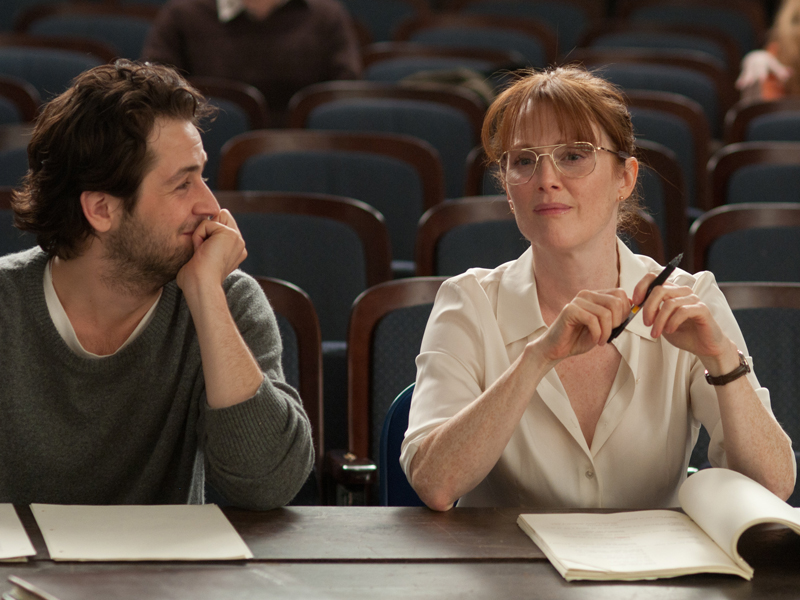
Even Julianne Moore can't save The English Teacher
The English Teacher (Dir: Craig Zisk). Starring: Julianne Moore, Michael Angarano, Greg Kinnear, Nathan Lane, Lily Collins, Jessica Hecht, narrated by Fiona Shaw. High school teacher Linda Sinclair (Moore) has loved books from an early age, contributing to a reader’s passiveness where she’s content to let others create the excitement. When a former student (Angarano) reluctantly returns home with a brilliant play, Linda campaigns to have the school premiere it. Her passion for the work, and the playwright, causes her prudent judgment to unravel. Soon, she’s in hot soup with the school and the writer’s father (Kinnear). Solid cast makes the movie work for about 40 minutes until the major plot twist is revealed. At that point, screenwriters Dan and Stacy Charlton abandon internal struggle for a strained lunacy that prevents us from knowing the characters beyond selfish irritants that cement Sinclair’s undeserved martyr status. There’s no logic anywhere, especially from the lead character. It’s hard to root for a 45-year-old woman who doesn’t know the difference between self-sacrifice and manipulation, never mind one whose behavior cannot be reasonably explained outside of a psychiatrist’s office. [R] *1/2 


Monday, June 3, 2013

The Big Review: The Kings of Summer

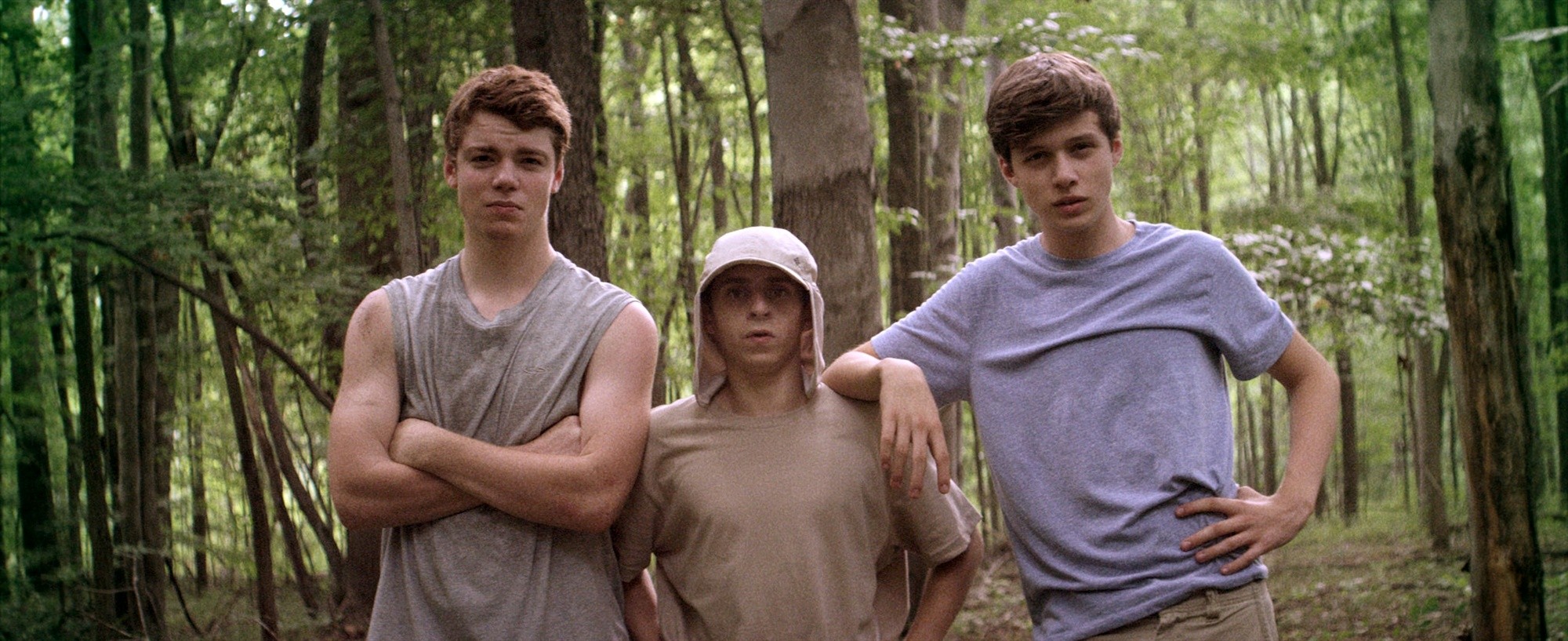
Yeah, look tough all you want, I'm still watching Moonrise Kingdom.
And the worst part is, this could have been really, really good. This review appeared in ICON and is reprinted with permission. 

By the way, I tried to see Before Midnight for this month, but the scheduling gods just didn't cooperate. My apologies. 

*****************

The Kings of Summer tries to be serious and funny and sentimental and dramatic. I’m sure there are other adjectives that I have momentarily forgotten, all of which are trotted out like sales techniques. Every time we know what we’re watching, director Jordan Vogt-Roberts rolls up his sleeves and starts another pitch that further obscures the movie’s identity. 

In suburban Ohio, Joe Toy (Nick Robinson) is a teenager on the brink. He lives with his dad (Nick Offerman), a widower who uses sarcasm and brusqueness as emotional armor. They’re not getting along. Example: Joe wants to go out. Dad, who has reinstated family game night to impress his girlfriend, says no. Monopoly ends with a visit from two police officers. It’s not the first time they’ve played mediator. 

Joe doesn’t care. He goes to a rowdy late-night party that gets broken up. While finding his way home, Joe and a random weirdo, Biaggio (Moises Arias), encounter a patch of verdant forest that practically glows. It’s a place where a kid can get away from everything, especially angry adults. When Mr. Toy hijacks Joe’s phone flirtation with the school babe (Erin Moriarty), a switch flips. Joe knows the woods can provide a better home than his dad. 

The proposal is equally appealing to Joe’s best friend, Patrick (Gabriel Basso), whose parents’ non-stop blather gives him hives. Biaggio joins the group, because according to Joe, “I don’t know what he’s capable of.” Joe draws up blueprints, and the boys pick up a mailbox here, a plank of wood there. Before you know it, a house is built. There are no parents, no rules, and infinite freedom. At least until the authorities get involved. 

Where did the boys get building materials? How long did it take them to erect this glorified, earth-bound tree house? The answers don’t matter when you’re profiling a boyhood utopia built on a foundation of pluck and naivety. Chris Galletta’s script lacks the awareness and whimsy found in Wes Anderson’s growing-up tales so The Kings of Summer keeps collapsing from the weight of its own disbelief. 

Joe’s dad and Patrick’s parents (Megan Mullally and Marc Evan Jackson) exist in sitcoms. Kids do not run away from people they’ve laughed at since age 5. They roll their eyes or ignore them. If that doesn’t work, they may distract themselves with recreational drugs and unprotected sex. Convenience store parking lots and bedrooms stocked with video games and DVDs also work. Running away and voluntarily going all Mosquito Coast is ludicrous. We know that. Presumably, so do Galletta and Vogt-Roberts, who, instead of acknowledging that, turn every adult character into a weirdo or a dope. We’re asked to take this youthful retreat seriously only to have that intent diminish with every goofy diversion—and there are a lot of them.  

Admittedly, it’s easier to bring the funny than deal with being 14 or 15 and feeling trapped as your parents’ tag-along. But when you’re heartfelt from a distance and sarcastic at close range, you breed contempt. We’re bombarded with easy laughs, yet no one considers how to work them into a tender story about boys being boys. So we’re subjected to poor Alison Brie (playing Robinson’s sister) sporting an effeminate, desperate-to-please boyfriend who sings “The Band Played On.” And a delivery guy who brings wonton soup with wontons the size of throw pillows. There’s even a doofus police officer. Come to think of it, the children don’t get away clean either. Biaggio is transparent comic relief, a miniature, autistic Christopher Walken. He serves no purpose other than to keep Galletta and Vogt-Roberts from challenging us. Or themselves. 

There is a good movie here, if anyone wanted to dig a little. The rapport between Robinson, Offerman, and Brie during family game night is wonderful. We know these three have endured a rough patch, but have enough love to fill the holes.  Vogt-Roberts could have used that history as a platform to examine the rift between Offerman and Robinson’s characters or to explore how Brie’s boyfriend sticks around. Joe’s fascination with one of his sister’s friends is a ripe subplot if everyone decides not to take the T&A highway. So many options exist that are more rewarding–and far less irritating--than what’s presented.

The Kings of Summer skirts the issues that cause teenagers to rebel and parents to hold tight. Vogt-Roberts hopes you’ll relish the puckish courage that comes in being young and not recognize that his movie is a long shimmering, laugh-desperate diversion. [R] 

Thursday, May 16, 2013

Review of "The Great Gatsby" (2013)

Actually, I would have preferred if Luhrmann had adapted The Happy Banana, which gives me an excuse to run this terrific clip. Carey Mulligan can bring the funny, people!


Oh, and if you want to read my review of The Great Gatsby for The Weekender, you can read it here. Really pleased it with for a strange reason. That never happens.

Monday, May 13, 2013

The Film Round-Up, May 2013: "At Any Price," "Mud," "Koch," "To The Wonder"

In this edition of the Film Round-Up: Heather Graham looks great, but her career? Uh...Matthew McConaughey's streak continues....The Ed Koch bio is quite good...And To the Wonder is a lovely poem of a film. 


My professional life is pretty isolated -- if you followed me on Foursquare, you'd probably kill yourself -- so it's always nice when to meet colleagues. And it's not just to prove that I can spit out sentence fragments and limply shake hands. 

When I went into New York last month, I met two people whom I've corresponded with and even worked for: Will Leitch, whose work I've admired for a while. (I also wrote a couple of pieces for Will when he edited Deadspin.) And I ran into Jesse Hassenger, the witty critic for The L Magazine, who is also a Twitter pal. Jesse, incidentally, is the first FilmCritic.com/Film Racket writer I've ever met in the physical world. Strange.

Meeting these two gentlemen was a highlight. It's so nice to know people outside their avatars.

Anyway, my apologies for just getting this stuff up now. I used to be vigilant about posting, but as my writing load has increased, the blog is getting pushed to the side more and more. Stuff will still post, but it won't be at the speed of my younger days. I'm trying to accept that. 

Boy, making a living is tough! I've hard to start my day at 10:30 a.m. now. I'm like a goddamned farmer. 

These four reviews all previously appeared in the May issue of ICON, and are reprinted with permission. Please read these, as I'd love to know if captured To the Wonder in less than 200 words. It's about robot detectives, right? 

###########


At Any Price (Dir: Ramin Bahrani). Starring: Dennis Quaid, Zac Efron, Maika Monroe, Kim Dickens, Heather Graham, Chelcie Ross, Clancy Brown, Red West. The corn country of Iowa is the setting for this modern-day family drama. Henry Whipple (Quaid, looking pained and awkward) is a seed salesman and farmer who wants to pass down the family business but finds no takers. One son is out climbing mountains in Argentina; the other, Dean (Efron, finally shaking off his awkward teenage star blues), is the town hotshot. He’s more interested in pursuing a NASCAR career than sweating over soil samples. As Dean and Henry butt heads, both deal with a heap of personal and professional issues that seal their futures. Bahrani and Hallie Newton’s overwrought, clunky script may steer audiences’ eyes toward their watches—or the exits. Every character is presented as a problem, a font of prairie wisdom, or, in Graham’s unfortunate case, a slut. Bahrani so overwhelms the story’s strong emotional foundation with conflicts that he overlooks something important: we have no reason to care about anyone in this confounding, frustrating movie. [R] **

Mud (Dir: Jeff Nichols). Starring: Matthew McConaughey, Tye Sheridan, Jacob Lofland, Reese Witherspoon, Sam Shepard, Ray McKinnon, Sarah Paulson, Michael Shannon, Joe Don Baker. Grungy Mississippi River boys Ellis (Sheridan, The Tree of Life) and Neckbone (Lofland) head to a small island to claim their bounty, a boat nestled in a tree, only to find that a charismatic, shaggy-haired refugee named Mud (McConaughey) is living in it. Ellis takes a shine to the man and offers food. The rapport grows deeper. Eventually, the boys try to reunite Mud with his girlfriend (Witherspoon) before an angry Texas mobster (Baker) discovers him. Writer-director Nichols (Take Shelter) delivers a fugitive story with different spins, all of them pleasantly surprising and heart-warming. Occasionally, it’s a growing-up story with Sheridan’s Ellis providing a splendid example of how to be a kick-ass young adult. Then, it’s about how women can turn the most stoic men into emotional wrecks. At the heart of Mud, and what makes it a gritty treasure, is its exploration of male relationships. Every man needs another man to love. It could be your dad, an uncle, or a filthy fugitive with superior muscle tone. Sheridan and McConaughey are excellent. [R] ***1/2

Koch (Dir: Neil Barsky). It’s very easy to categorize Ed Koch, the three-time New York City mayor who died February 1 at age 88, as a borscht belt bully; a guy who was a little too in love with himself and his agenda. This touching documentary provides a heaping dose of perspective, and not just in defining Koch’s political legacy in New York, which includes affordable housing and starting Times Square’s renovation. Barsky provides context to Koch’s personality. He embraced the theatrics of politics. Whether it was staging a relationship to quell rumors of his homosexuality (never confirmed) or playing the role of heavy with the press or putting on his “how I’m doin'?” everyman shtick, Koch knew how to get the city’s attention. Love him or hate him—and Barsky finds plenty of sources in the latter camp—Koch represented the politician as schmoozer. The public life was his life. Away from the cameras and hellos, Barsky shows a man unfamiliar with the concept of solitude. Koch, a Jew, is buried at Trinity Church’s non-denominational cemetery. His reason? It’s bustling. A stellar directing debut from Barsky, a former journalist. [NR] ***

To The Wonder (Dir: Terrence Malick). Starring: Ben Affleck, Olga Kurylenko, Javier Bardem, Rachel McAdams, Tatiana Chiline. Malick’s latest tone poem/meditation on the everyday has Neil (Affleck) bringing paramour Marina (Kurylenko) and her child (Chiline) from Paris to suburban Oklahoma, where domesticity slowly poisons everything. She and the child leave. He stays and begins a new relationship with a childhood acquaintance (McAdams), one his taciturn nature can’t sustain. Marina returns. Resentment builds. And in the middle of all this the town’s priest (Bardem) finds his faith crumbling. Like he did in The Tree of Life, Malick uses cryptic, thunderous narration and Emmanuel Lubezki’s museum-worthy cinematography to present (to paraphrase Tennessee Williams) a haunting memory film. With intense relationships, we don’t remember the details. It’s the grandness of our feelings that lasts. Some will call Malick’s presentation pretentious; others will call it brilliant. Say anything you want; don’t say you’re not engaged. So many directors spoon-feed us the answers. Malick, bless his heart, never stops challenging us to think beyond concrete concepts. [R] ***1/2

The Big Review: "What Maisie Knew"

Julianne Moore with her possession, ah, daughter (Onata Aprile) in What Maisie Knew
I can't think of a better movie to celebrate Mother's Day. Wait, that's not right.

This review previously appeared in the May issue of ICON and is reprinted with permission. Yo, Philly: The flick opens on May 24.

************


The six-year-old endures the shouting and the name-calling. It goes on all day, so there’s no choice. Her options are few. She can’t leave. She can’t fight. So she observes and catalogues the slights.

She looks up a lot, like she’s praying for a reprieve.

What Maisie Knew, directed by veterans Scott McGehee and David Siegel, is a stirring examination of a child stuck in purgatory. It captures the knee-high world of its title character (Onata Aprile) while illuminating the flaws of adults.

Maisie’s parents, Susana (the indispensible Julianne Moore) and Beale (Steve Coogan), are too busy engaging in a non-stop verbal battle to pay much attention to their daughter. The words no longer impact Maisie, who just makes a snack or grabs a tip for the pizza guy while mom and dad shout through closed doors. The one stable adult presence is Margot the nanny (Joanna Vanderham), whose warmth and enthusiasm provides an umbrella from the storm inside.

Predictably, Susana and Beale part ways. Things, however, get worse for the most mature member of the family. Susana, a fading rock star, is so consumed with getting custody that she hastily marries nice guy bartender Lincoln (Alexander Skarsgård) to score points with the judge. It’s the desperate whine of an overgrown child who wants her doll back, and matrimony doesn’t quell Susana’s shameless narcissism. When Lincoln bonds with Maisie at her recording session, a hurt Susana intercepts the attention and asks Maisie to join her in the booth. Beale, concerned about his career momentum, marries Margot after a courtship of about five minutes. (Guess the maid was off that day.)

Susana and Beale’s new spouses learn very quickly that they are around to do the unpleasant work: pick-ups and drop offs and making meals and ostensibly raising Maisie. Margot and Lincoln, who don’t treat Maisie like an adorable prisoner shuffled between luxurious New York City confinements, grow to love the child, and she them.   

Siegel and McGehee, working from Carroll Cartwright and Nancy Doyne’s screenplay, proceed with no preciousness and tons of assurance. By having every scene focus on or around Aprile, who acts like a kid instead of a kid actor, we get a merciless, impartial judge who doesn’t miss a thing. A child doesn’t care about limitations or intentions. That’s adult stuff. Results matter. That observational frame means the filmmakers don’t have to traffic in obviousness, and we can see the characters’ shortcomings as flaws, not cartoonish traits. Aided by Moore and Coogan’s fine, measured work, Susana and Beale’s biggest crime is that they love themselves more than their daughter. Meanwhile Skarsgård and Vanderham’s ease with each other tells you more about their burgeoning relationship than any monologue could.

What Maisie Knew doesn’t need to shout. It lays out the action and trusts you to put everything together. Still, there were times watching when I wished the movie, an update of Henry James’ novel, were more cutting and more obvious. Too many couples are in Susana and Beale’s situation, and they got for the same set of stupid reasons. The baby was a must-have accessory or an item to be checked off the “I can have it all!” checklist. Or maybe, consumed by disappointment and unmet expectations, they thought a kid would fill the void or make them better people.

Rants rarely make for good movies, and the message of the last, lovely scene in this quiet gem is, in its own way, very loud: The problems of adults belong to no one else. A child’s only responsibility is to be a child. [R]