Saturday, January 5, 2013

The Big Review: "Django Unchained"

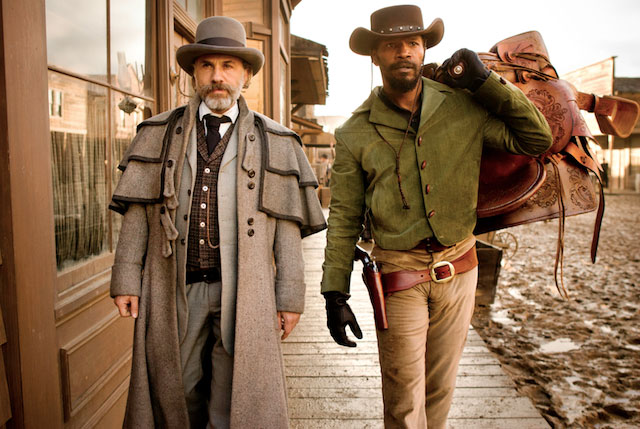
Pictured: The only non-violent scene in "Django Unchained." 
One of the best movies of 2012--and probably the hardest review to write. I'm still not sure if I nailed it, but hey as long as the check doesn't bounce...

This review appeared in "ICON," and is reprinted with permission.

*************

Quentin Tarantino’s 1994 masterpiece Pulp Fiction was the first time going to the movies felt life altering. Ten years later, after Kill Bill: Volume 2, I had given up on the fast-talking auteur. Something was amiss. It felt like he was too busy living in other worlds, sampling movie memories from his childhood and video store days, instead of creating his own.


With some hesitation I reacquainted myself with the writer-director by watching Django Unchained. I’m glad I did. It feels like the Tarantino who won me over in October 1994: cool, insightful, dying to get your attention. He’s back to being the wild child having too much fun with his chemistry set. It’s one of the few movies in 2012 that caused me to leave the theater with a swagger—while feeling a little regret over my self-imposed abstention.

Taking place in 1858—“two years before the Civil War,” according to Tarantino—Django Unchained never walks in a straight line. In Texas, dentist-turned-bounty hunter King Schultz (Christoph Waltz) buys a slave named Django (Jamie Foxx) to track down Django’s former overseers. This begins a successful partnership that spans several months and many dead bodies before a final assignment: retrieving Django’s estranged, still enslaved wife, Broomhilda (Kerry Washington), from a Mississippi dandy plantation owner named Calvin Candie (Leonardo DiCaprio).

Now a free man, Django poses as a talent scout for Schultz, who plays a big spender eager to pursue Candie’s love of slave fighting. The partners are forced to stay at the Candieland estate, which only aggravates the pain underneath Django’s freedom. Schultz, a gentle soul, is the only one who treats him like a person. And he’s constantly asking Django to assume a role, whether it’s posing as a fancy-pants valet or picking off bandits. Django tells a concerned Schultz he’s “getting dirty” by antagonizing Candie’s crew. The man is not just talking about his acting approach.

Django suppress his rage and betrays his race; Schultz has to battle his moral consciousness. We know this because Schultz never lords Django’s past over his head. He was hired for a job, so why are people staring when they ride horses into town? Schultz may be the latest in Tarantino’s line of eloquent cold-blooded killers, but he has a soul. When Candie is about to sic the dogs on a runaway fighter who cost him a measly $500, Schultz offers a reimbursement. Django overrules him. Morals don’t exist in this world.

What happens to that slave propels both men toward a bloody, cathartic fate. The beauty in Tarantino’s approach here is that the excessive violence doesn’t damage the characters’ substance. Foxx (taking over for Will Smith) and Waltz summon the emotional toll of their characters’ work, but they have fun. You can hear Waltz—it’s impossible to overstate how good he is—relish the twisty lines of dialogue Tarantino provides. And the angrier Foxx gets, the better he is. You can hear the rage boiling even as Schultz cools him down with each kind gesture.

Some may say that Tarantino is wallowing in stereotypes and shock, whether it’s the almost non-stop utterance of “nigger” or Samuel L. Jackson’s simian resemblance. As Schultz might say, it’s part of the show. It’s clear that Jackson, playing Candie’s ancient house slave, runs Candieland. And the violence, exquisitely captured by cinematographer Robert Richardson, is frequently comic relief. Schultz shoots a small-town sheriff dead, but no one reacts until a woman faints. Before Django ambushes a room of grizzled bad guys, we see one painting a birdhouse. Tarantino, playing a rascal with a vague accent, becomes a real-life Yosemite Sam, holding sticks of dynamite at the worst possible moment.

Tarantino’s willingness to question the decorum of whatever genre he’s honoring made me love Pulp Fiction, a trait that endeared me to Django Unchained: a plantation owner (Don Johnson) figuring out how to communicate with a free black man; a nascent version of the Ku Klux Klan (whose members include Jonah Hill) getting stymied by poorly constructed hoods; a defenseless slave driver begging for forgiveness by reminding one of his angry workers that he once gave him an apple.

Every reason I’ve expressed for liking Django Unchained sounds contradictory. Part of the fun is watching Tarantino connect the dots to produce something this entertaining and enriching from disparate elements. It’s a hell of a trick, and a terrific movie. Wieder sehen, Quentin. [R]

The Film Round-Up: January 2013: Promised Land, Not Fade Away, Hyde Park on Hudson, Deadfall


"Maybe if we drink we can forget about being in "The Words."
I gotta say. Olivia Wilde is becoming like Michael Pena or Dennis Quaid. I'm thrilled to see her--I really think she's a good actress--even though I know the movie she's in will probably be terrible. It's like ordering a salami sandwich from a vending machine. It's tasty at first, but later you don't feel so good.

As for Quaid, his 2012 should have belonged to Randy: "The Words, (with Olivia Wilde!)" "What to Expect When You're Expecting," and "Playing for Keeps." Good God. How depressing.

These reviews were previously published in "ICON" and are reprinted with permission. 

***************

Promised Land (Dir: Gus Van Sant). Starring: Matt Damon, John Krasinski, Frances McDormand, Rosemarie DeWitt, Hal Holbrook, Titus Welliver, Terry Kinney. Corporate sweet-talker Steve Butler (Damon, reteaming with Good Will Hunting director Van Sant) is sent to rural Pennsylvania to convince townspeople to lease their land so it can be tapped for natural gas. Everyone prepares for a big payday until the resident science whiz/sage (Holbrook) objects, leading to the arrival of a young, charming environmentalist (Krasinski). Steve soon reconsiders what he’s representing. We never buy the doubt. And it’s not because Damon is too busy wearing the earnest beret to don the black hat: he actually tells the obligatory love interest (DeWitt) that he’s “not a bad guy.” Steve is an old pro so we never believe that his conscience would suddenly wobble when faced with simple wisdom from the farmland. (If he and Krasinski switched roles, that might work, though The Office heartthrob would have had to contain his unbearable smugness.) By the end, Promised Land has gotten away from the thorny issues that pierce the soul and celebrates simple, obvious values represented by American flags and smart little girls selling lemonade.  It makes for a wonderful PSA. As a movie? Not so much. Damon and Krasinski wrote the script. [R] **

Not Fade Away (Dir: David Chase). Starring: John Magaro, Bella Heathcote, Jack Huston, Will Brill, James Gandolfini, Brad Garrett, Christopher McDonald. The Sixties were a crazy time, man. That’s the message behind the pointless, aggravating directorial debut of Chase, the creative force behind The Sopranos. A drum-loving Jersey boy (Magaro) starts off as a straight arrow eager to join the military. Then he dives headlong into rock and roll, forming a band, letting his hair go electric, and having a tempestuous relationship with a student from the Marianne Faithfull School of Bored-looking Beauties (Heathcote). These developments enrage his parents (Gandolfini and Molly Price), graduates of the Whatsa Matta University of Working Class Stereotypes. It’s a long slog. Every guitar pick-thin character can be described through labels: hippie, square, concerned parent. Chase’s idea of propelling the plot is to introduce another crisis. The ending seems lifted from another incredibly pretentious movie. Behind these egregious faults is a stifling blandness. The film’s cultural revelations and you should-have-been-there incredulousness—We made a bong from a toilet paper roll! The Beatles changed everything!—are second-hand. Chase somehow thinks this is all new information when it’s been covered, analyzed, and parodied since the first episode of Laugh-In. [R] *

Hyde Park on Hudson (Dir: Roger Michell). Starring: Bill Murray, Laura Linney, Samuel West, Olivia Colman, Olivia Williams, Elizabeth Marvel. ­­The latest in a line of nostalgia-tinged naughtiness (My Week with Marilyn, Hitchcock) takes us to June 1939. A perfect storm is forming over President Franklin Delano Roosevelt’s home in Hyde Park, NY. Habitual paramour and distant cousin, Daisy (Linney), is in love with FDR (Murray); wife Eleanor (Williams) lives elsewhere, and the King and Queen of England (West, Colman) are coming for an important weekend visit. Cue the flustered rich folk! Prestige picture is written all over this effort, but writer Richard Nelson can’t decide on the angle. Every shift of perspective—from forbidden love story to comedy of manners to political drama—is jarring and incomplete. And Michell’s polite, folksy approach guarantees that the movie seals lids shut instead of blowing them off. Don’t let the MPAA rating fool you. Watching Hyde Park on Hudson is like watching slides of your great-grandparents’ vacation to upstate New York—with a few boudoir shots thrown in for spice. [R] **

Deadfall (Dir: Stefan Ruzowitzky). Starring: Eric Bana, Olivia Wilde, Charlie Hunnam, Sissy Spacek, Kris Kristofferson, Kate Mara, Treat Williams. Following a horrible car accident, two bank robbing siblings (Bana, Wilde) separate and hope to reunite in the wintry backwoods. Sis hitches a ride with a disgraced Olympic boxer (Hunnam) who is running from a new set of problems. Meanwhile, bro kills at a furious rate, making his way to the home of a couple (Spacek, Kristofferson) for a Thanksgiving dinner that ends up fit for a hostage negotiator. “This is like an old movie, don’t you think?” Wilde’s character observes. A little too much, actually. Director Ruzowitzky (The Counterfeiters) and first-time screenwriter Zach Dean aren’t interested in telling new stories. Deadfall recycles elements of Fargo, Scarface, The Ref and other hard-boiled fare but offers little to keep our interest. The finale is more implausible than intense and the ill-fitting performances range from muted to cartoonish, but the absence of absorbing characters and conflicts really keeps us from warming up to this snowy thriller. [R] **

Monday, December 31, 2012

My New Year's Resolution...

To see fewer films like this...


And more films like this...


Of course, I'd like to increase my output here. What can you expect in the coming weeks?

1.) Our interview with Joe Queenan
2.) A big, fat review of "Django Unchained"
3.) Our Year in Review
4.) An essay from film critic turned filmmaker Jeremiah Kipp
5.) And much, much more.

Thanks to all who have read, commented, and put up with the noise. Your checks are in the mail. Happy New Year!

Wednesday, December 26, 2012

Review of "Les Miserables"

One day more? No, thanks.
My last review of 2012 for "The Weekender." Read my musings on the emotional inauthenticity right here. And if you're going to a regular showing, please try not to sing along like the one moron at the critics' screening I went to last month. Really, don't do that--especially when people have asked you repeatedly to stop.

This began a trend of awful audience behavior, which included a member of the Philadelphia Film Society barging his way to the front of the line for a screening of "Promised Land." That was followed by two dirtbags stealing a critic's reserved seats.

What's remarkable about the latter act was the two men, according to my wife, went their separate ways after they were caught. It was like a warm-hearted Christmas story involving grifters. Maybe David Mamet can write a homogenized romantic script for Fox Family: "Alicia Silverstone and Jay Mohr star in The Christmas CON-nection."

Oh, and my apologies for not wishing everyone Merry Christmas yesterday. Sorry, Santa. Sorry, Jesus.

Wednesday, December 12, 2012

Review of "Playing for Keeps"

Oh, Gerard Butler....What are you doing?

Watching "Playing for Keeps"--my review for "The Weekender" can be found here--I couldn't help thinking about him and Jeremy Renner. Butler, of course, became a household name after his rough-and-tumble work in "300." Renner, with a look straight from a Wrangler jeans ad, found his profile rising after "The Hurt Locker."

In 2012, Renner is a gigantic star while Butler is trying to find the emotions within Jessica Biel, a fool's errand if ever there was one.

What gives?

Renner has shrewdly decided to star in movies that duplicate what made him so appealing in "The Hurt Locker": stoic, mysterious tough guys. Butler hasn't gone back to the well, starring in a string of romantic comedies that have turned him into the guy who buys roses after the first date. The ladies are smelling the desperation, and guys can't figure out why Butler wants to follow the footsteps of D.B Sweeney or Andrew McCarthy.

I mean this is as a compliment, but Butler is a walking erection. He should be insulting his superior officer, shooting people in the face, and bedding women half his age. In a time when everyone is too polite and too aware of decorum, we need a rule breaker now more than ever.

Sunday, December 2, 2012

Film Round-Up: December 2012: Dying To Do Letterman, Funeral Kings, Anna Karenina, Silver Linings Playbook

I can't imagine how much "Silver Linings" would have grated my ass if Cooper and Lawrence weren't in it. I probably would have ranted like Joel Siegel during his infamous Clerks 2 screening.

These reviews appeared in the December issue of ICON and are reprinted with permission. 

*********
Dying to Do Letterman (Dirs:  Joke Fincioen and Biagio Messina). Diagnosed with inoperable liver cancer, stand-up comic Steve Mazan sets a goal in January 2006: to perform his act on Late Show with David Letterman within a year. (For comparison’s sake, Ray Romano tells Mazan he spent 11 years before Letterman proffered an invitation.) An Internet campaign gets attention, but not in a good way. An executive producer informs Mazan, who has at worst five years left, that appearing on the show is impossible. Determined to get there on skill, he develops new material, hits the clubs, and deals with mounting pressure from creditors and his wife, Denise, who is eager to start a family. The earnestness and dignity of Mazan, who is actually quite funny, makes you pull for him as he navigates his personal issues and the frequently frustrating world of professional stand-up comedy. An entertaining and enlightening documentary. [NR] ***1/2


Funeral Kings (Dirs: Michael and Kevin McManus). Starring: Dylan Hartigan, Alex Maizus, Jordan Puzzo, Charles Kwame Odei, Kevin Corrigan. The not-so dangerous lives of altar boys. It’s another typical week for friends Andy (Hartigan) and Charlie (Maizus)—copping altar wine, leering at cleavage, cutting class—filled with a few eventful developments. Andy’s wayward older brother has left behind a locked trunk. The new altar boy (Puzzo) is kind of a square, though he did star in a big movie with alleged nudity, which makes him a millionaire. And there’s a high school party—with beer and girls—they have to figure out how to attend. Deliberately paced, slice-of-life comedy/drama is more concerned with moments and tone than an actual narrative arc, which is a bit frustrating. Cast that aside and you get a gentle reminder of how big and scary and wonderful the world is as a 14-year-old boy. At that age, survival is based on how much bluster you can muster and endure. The McManus Brothers’ feature directorial debut. [R] ***

Anna Karenina (Dir: Joe Wright). Starring: Keira Knightley, Jude Law, Aaron Taylor-Johnson, Kelly Macdonald, Matthew Macfadyen, Olivia Williams, Emily Watson. I have not read Leo Tolstoy’s classic novel, but I will after thoroughly enjoying Wright’s haunting adaptation. Here, the scenes are set up as a play, giving a sweeping theatricality to the title character’s epic late-19th century tale of woe. Anna (Knightley), a devoted mother married to a government official (Law), is perfectly content as a pillar of St. Petersburg high society. When Anna visits Moscow to help alleviate the rift between her sister-in-law (Macdonald) and her relentlessly cheating brother (Macfadyen), she meets the dashing Count Vronsky (Taylor-Johnson). Knowing the trouble in betraying her dull husband, Anna initially resists Vronksy’s advances but ends up eschewing convenience for love—and discovers the consequences in following your heart. Terrific story, which (sadly) still has relevance today, becomes electric thanks to the breathtaking work of cinematographer Seamus McGarvey and production designer Sarah Greenwood. You cannot look away as Anna’s world turns from magic to misery. Knightley is excellent. Screenplay adapted by Tom Stoppard. [R] ****

Silver Linings Playbook (Dir: David O. Russell). Starring: Bradley Cooper, Jennifer Lawrence, Robert De Niro, Jacki Weaver, Chris Tucker, John Ortiz, Anupam Kher, Julia Stiles. Against all good judgment, Pat, a troubled young man (Cooper), leaves a Baltimore insane asylum early for the comfort of his Philadelphia-based parents (De Niro, Weaver) determined to find his silver lining: reconciling with his wife and returning to substitute teaching. Such optimism, given the restraining orders involved and Pat’s unbalanced behavior, is delusional—until he’s introduced to young widow Tiffany (Lawrence), another tortured, attractive soul. Tiffany agrees to reach out to Pat’s wife, if he becomes her dance partner. Philly native Cooper, shedding his handsome guy act, and Lawrence are terrific together, so you occasionally forget Russell’s heavy-handed treatment of the material. Again, The Fighter director uses the feel-good genre as a club, slamming us with inspirational dialogue (conveniently listed on the poster) and sweep-us-off-our-feet camerawork, giving the movie a disingenuous feel. But what’s particularly galling is how Russell, working from Matthew Quick’s novel, keeps honoring the lower middle-class by caricaturing them, burying Pat and his family’s dignity with each Eagle jersey and working class accent. Silver Linings Playbook is a snob’s version of how real people live, so it will probably rule the Academy Awards in three months. [R] **

The Big Review: "Hitchcock"

The peerless Matt Zoller Seitz asked on Twitter if there was any reason why he should watch this. I replied: "You get to see Jessica Biel in a bra." 

This review appeared in ICON and is reprinted with permission. Also, kids, if you want to read the review online, please head to www.icondv.com. But be sure to come back here, you hear? 

*****************
Let’s start with the obvious:  In Hitchcock, Anthony Hopkins looks nothing like the great director. Crammed into a fat-suit, his handsome features barely distorted by buttery jowls, he resembles Jeffrey Tambor—if the Arrested Development actor swallowed a large beach ball and had his legs amputated. The image created is a constant distraction that places Hopkins, a wonderful actor, in a hopeless situation.

Good news for Hopkins, if you can call it that: he’s not the lone faulty party. Sacha Gervasi’s biopic is a lumbering, forgettable collection of half-thoughts. Aside from Hopkins’s stupendous non-transformation, the film’s other memorable aspect is its ironic refusal to create a stir.

Gervasi (Anvil: The Story of Anvil) does one thing right, focusing on a distinct period of time. It’s 1959 and Hitchcock, 60 years old and his legacy secure, is high on the success of North by Northwest. The feeling is over in minutes. “Shouldn’t you quit while you’re ahead?” a reporter asks after the premiere. In an unfortunate harbinger of the movie’s style, thunder crashes in the distance.

Hitchcock is determined to find something fresh. He passes on The Diary of Anne Frank and Casino Royale. Neither is a “nasty, little piece of work.” Psycho, a new book about mother-loving serial killer Ed Gein, fits the bill nicely. A skittish Paramount won’t make it, so Hitchcock finances the movie—a whopping $800,000—himself. Why go through the trouble? “I want to feel that kind of freedom again,” he tells his wife, Alma (Helen Mirren), who has been his creative lifeblood from the beginning.

Alma is the strong woman behind the famed shapely silhouette—killing Marion Crane in Psycho’s first 30 minutes is her suggestion—but she’s tired of getting second billing. She’s tired of her husband’s obsession with beautiful, young blondes. She’s tired of being at his beck and call. She’s tired that she can’t carve her own niche other than being the faithful, supportive Mrs. Hitchcock. It’s been going on too long, so you can’t blame Alma when her dapper married friend (Danny Huston) gets increasingly chummy during their writing collaboration.

The conflict behind Alma and Alfred’s union would make for a compelling film. It’s too bad Hopkins looks like a human Grimace. But Gervasi wages a constant battle with no clear winner: recalling the last golden age of Hollywood movies vs. reveling in its dark undercurrent. John McLaughlin’s script focuses more on revealing facts about the production, which keeps the movie locked at a strolling pace. Gervasi’s stabs at darkness are either unintentionally comical (Hitchcock taking out his anger on a pool skimmer) or, reminiscent of that aforementioned lightning bolt, condescending and overdone. Hitchcock periodically talks to Gein (Michael Wincott) and envisions all his enemies as he shows Anthony Perkins (a perfectly cast James D’Arcy) how to stab Janet Leigh (Scarlett Johansson). There’s a politeness to those scenes, which would have benefitted from utilizing Hopkins’ famed intensity. It’s too bad he resembles the Michelin Man in a suit.

Missed opportunities accumulate. Two wonderful actresses are present. One is used sparingly (Toni Collette) and the other (Johansson) serves as a subterfuge for Hitchcock’s blonde ambitions. That’s what you hire Jessica Biel, cast here as Vera Miles, for. The feisty, independent Alma gets defined with a stock “you need me” speech and by replacing her ailing husband on set, a scene so hokey that it should have been accompanied by “I Am Woman.” (I won’t even go into the ending.) Hitchcock could have been a Hollywood satire veiled in Eisenhower-era stodginess, a merciless portrayal of a tortured genius and his unsatisfied wife. Instead, it just stands there— one foot in the sunshine, the other in the darkness—wasting our time. [PG-13]