Monday, February 1, 2010

Review of Up in the Air

Pictured is New Jersey's very own Vera Farmiga, perhaps the one good reason you should watch Up in the Air. Listed below is why you really shouldn't.

This review originally appeared in ICON and is reprinted with the loving permission of Trina Robba.

Enjoy!

It happens every year: A movie seduces critics, moviegoers, and everyone else but leaves me cold. In 2009, I encountered three: The Coen Brothers' A Serious Man, Lee Daniels' Precious: Based on the Novel "Push" by Sapphire, and now Jason Reitman's Up in the Air, starring George Clooney.

The last film, which should make headlines after Oscar nominations are announced Feb. 2, revolves around these troubled times. It's the kind of film that oozes relevance and a deeper meaning—if a filmmaker commits to that agenda. Reitman doesn't. He's never entirely sure whether he wants to offer a character sketch or a movie about the big world. A movie for our times, a description I've heard in commercials for Up in the Air, can't be wishy-washy even if we are.

Ryan Bingham's job is to relieve people of theirs. For over 300 days a year, Ryan (Clooney) crisscrosses the country, doing the dirty work of CEOs. His life is sparse and efficient. There's no wasted space, no superfluous motions. It should come as no surprise that he never sees his family—his reaction to his sister's marriage ranges from indifference to annoyed—or has a meaningful relationship. It can't fit in his suitcase.

His organized little world gets a major jolt when his young go-getter colleague, Natalie (Anna Kendrick), unveils a plan to modernize their firm that the higher-ups love. No more will Ryan and his co-workers fly across the country, a costly endeavor that has allowed Ryan to proudly amass nearly 10 million airline miles. Firings will now be done via teleconference from the home office in Omaha to wherever the recession has claimed its next victims, with a headset-wearing "transition specialist" doing the dismissing.

It's a fitting idea from Natalie, who sounds like a corporate mission statement, but Ryan hates it, namely because what he does can't be simplified via technology. There's a technique involved, something that Natalie can't comprehend. Two side notes: Ryan hates being home; his identity is in the air. Being grounded also eliminates his time with amorous travel buddy Alex (the excellent Vera Farmiga). Ryan and Natalie's boss (Jason Bateman) has a unifying solution: Ryan will take Natalie on the road to show her what he does.

The trip, peppered with visits to bankrupt companies and airport lounges, turns out to be an eye-opener for both. Natalie learns that the people she wants to use as guinea pigs for her career advancement have feelings, and that her pre-planned course for success is a joke. Thanks to Alex, Ryan learns the value of companionship, of having someone in your corner. And he realizes this while attending his sister's Pabst blue-collar wedding, which undoubtedly satisfies his multi-tasking streak. Whether Natalie and Ryan can endure these changes is a different story.

Up in the Air does offer enough internal crises regarding Ryan and Natalie to keep the movie involving, but Reitman and co-writer Sheldon Turner never align this development with the tumultuous world the characters navigate, one where personal connections are being replaced by technological convenience and the bottom line. The groundwork for a movie with a larger message is begun and we get little tastes: empty offices, tearful employees, etc. But it's used as a garnish, a quick and dirty way to add importance to a story about a corporate drone searching for himself. By giving this tumultuous world idea short shrift, Reitman confesses that it's not that important. It's scared filmmaking: You either make your grand statement on the world, or you save the soapbox for another time. Hedging your bets, hoping that people will confuse flashes of meaning for meaningful, is remarkably condescending.

Ryan has built his career telling people that they've become irrelevant. Now he's facing the same fate, which he has escaped by traveling non-stop. His time is up. That's great, but Turner and Reitman never flesh out Ryan's profile. We never learn how Ryan got to thrive on solitude, and how his family became an inconvenience. What causes a man to become so content living out of a suitcase that he gives lectures on the subject? One could say that Ryan's blank personal history works because the movie involves him opening up, but the evolution is pointless if we have no idea where he started.

That we know Alex better than Ryan highlights the need for two distinct personas to survive in the business world. Still, I couldn't help but wonder if she could have lent one to Ryan. Every strong move here is met with a weaker one, like stocking the supporting cast with Bateman, J.K. Simmons, and Danny McBride so they can play the same old roles. It's fitting that the grand ideas espoused by Up in the Air are tripped up by smaller details, ones that Oscar voters will blithely ignore. [R]

The Film Round-Up for February

In this edition of the Film Round-Up: An unhinged detective, a steel magnolia, a father wading through the destruction of the apocalypse, and why you should be afraid of Nancy Meyers.

These reviews previously appeared in the February issue of ICON and are reprinted with permission. (Thanks, Trina).

In reviewing offbeat and independent films, I missed most of what the multiplex offered in November and December, when studios unload their Oscar hopefuls. With Academy Award nominations coming Feb. 2, I figured it was high time for me to catch up.

Sherlock Holmes (Dir: Guy Ritchie). Starring: Robert Downey Jr., Jude Law, Rachel McAdams, Mark Strong, Eddie Marsan, Kelly Reilly. A beloved literary character gets a movie makeover, and the result is a rollicking, vastly entertaining start to a certain franchise. In late 19th century London, renowned detective Holmes (Downey Jr.) and his trusted partner Watson (Law) follow a disgraced politician (Strong), whose apparent resurrection and enthusiasm for black magic threatens to bring the country to its knees. Thrown into the mix is Holmes' old flame (McAdams), a brilliant con artist whose shifting allegiances keep everyone on edge. Ritchie (Snatch) slows down his hyper-kinetic style to tremendous benefit: The movie runs like a champ while establishing Downey Jr. (who's perfect—just the right mixture of mischievous and confident) and Law's snippy brotherly rapport, the real reason to watch the movie. The talented McAdams, however, has trouble finding her footing. The character has no hook, and she's not seductive enough to give it the proper oomph. Other than that, Sherlock Holmes continues an emerging trend: big-budget, well-written action-packed blockbusters (e.g., Star Trek, Iron Man) that everyone can enjoy. [PG-13] ****

It's Complicated (Dir: Nancy Meyers). Starring: Meryl Streep, Alec Baldwin, Steve Martin, John Krasinski, Lake Bell. Jane (Streep) and Jake (Baldwin) have been happily divorced for 10 years, an arrangement that has served them and their three grown children well. While in New York for their son's college graduation, the divorcees have a one-night stand, which blossoms into an exes-with-benefits deal. However, the passionate arrangement hits a snag when the unhappily remarried Jake develops real feelings for Jane just as she's dating the nice-guy architect (Martin) working on her house. Like her previous movies (Something's Gotta Give, The Holiday), Meyers has a knack for breezy dialogue and getting charming performances from her leads. And like her previous movies, Meyers' insistence on setting them in luxurious locations and giving her heroines ridiculous occupations—Jane owns the kind of gourmet bakery that sells $8 muffins to a willing public—belittles the message of strength that she's espousing to a graying sisterhood, most of whom are battling problems in houses far smaller than Jane's garish addition. By portraying real problems in a fantasyland farce, Meyers has brought baby boomer problems to the masses. That's admirable, but her cutesy, compromising style casts a pall over the entire film. [R] **

The Blind Side (Dir: John Lee Hancock). Starring: Sandra Bullock, Tim McGraw, Quinton Aaron, Jae Head, Lily Collins, Kathy Bates. Before he made the NFL as a left tackle in 2009, Michael Oher essentially grew up homeless and forgotten in the nasty Memphis projects. Thanks to his huge size and freakish athletic ability, Oher got into a fancy private school as a teenager. But Oher (who is black) got a home, encouragement, and much-needed stability from the affluent (and white) Tuohy family, whose children attended the same school. Bullock plays Leigh Anne Tuohy, the indisputable head of the family, a feisty but loving steel magnolia who invites Oher (Aaron) into her home and shepherds him through the school's rigorous academics and to his eventual athletic success. Yes, the movie shamelessly guns for Oscar votes with its making-a-difference tone and dramatic showboating, but it works thanks to the gripping story and Bullock's spirited performance. The Blind Side is the kind of well-intentioned, morally superior fare you keep waiting to hate but never do. It entertains and uplifts you against your better judgment. [PG-13] ***

The Road (Dir: Jon Hillcoat). Starring: Viggo Mortensen, Kodi Smit-McPhee, Charlize Theron, Robert Duvall, Guy Pearce. The world is dying, but not in an Al Gore, down-the-road kind of way. Fires and earthquakes are now part of the scenery. The land is barren and the skies are gray. With food scarce and survival paramount, packs of marauding, gun-toting cannibals hunt for fresh meat. Thrown into this awful new reality, a father (Mortensen) and son (Smit-McPhee) search for food, shelter, and a reason to continue. Adaptation of Cormac McCarthy's novel is relentless in its nervous misery, but hopeful in its lasting message. Equipped with a wild beard and gaunt frame, skeptical and world-weary, Mortensen is exceptional in the lead, matching the movie's stark visuals. Theron is very good as Mortensen's defeated wife, who we see in flashbacks. Two factors prevent the movie from being truly great, and why you probably haven't heard a ton about it: Mortensen's almost redundant narration and Smit-McPhee's performance, which is more whiny and needy than wide-eyed and terrified. [R] ***

Saturday, January 30, 2010

January's Book of the Month


I love books. They're fun, educational, and you can learn all sorts of cool words. Like "kitten."

Anyway, I'm about to wrap up a Dyalogue with everyone's favorite movie buddy R. Kurt Osenlund on narration in movies. I think it's a pretty good one, even though Kurt is probably about to explode over my disdain for "Up in the Air".

In our spirited exchange, I mentioned Philip Roth several times. It came to my attenion that I should call some attention to probably the greatest living American novelist. Here's the weird thing: as he gets older, his writing is still dynamic and insightful and energetic. He's a modern-day miracle.

Please don't watch his adaptations. "Elegy" was sleepy (I didn't read "They Dying Animal") and "The Human Stain" was absurd thanks to its preposterous casting. Just read any of these books from America's crankiest novelist:

1.) The Human Stain
2.) Portnoy's Complaint
3.) American Pastoral
4.) Portnoy's Complaint
5.) The Plot Against America
6.) Patrimony (his outstanding memoir about his father's failing health)

Happy reading to everyone.

I'm Such a Newshound


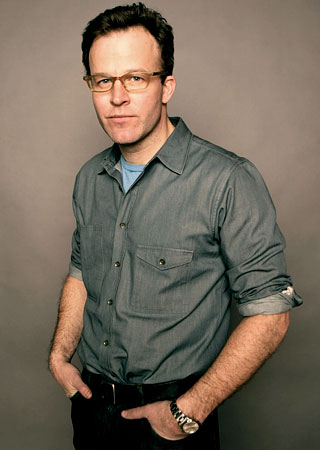
A few weeks back I posted that I written a profile on Tom McCarthy for "Park Place", a sister publication of "New Jersey Monthly". I'm proud of the piece, specifically because I busted my ass on it.
It took nearly two years from the idea phase to the story being printed in November. Here's a brief timeline, according to my hazy memory.

Consider this a look into the glamorous world of professional writing.

July 2008: Am invited by Overture Films to a screening of McCarthy's The Visitor. Impressed, I remember that McCarthy is a New Jersey native. Remember that I have a contact at "New Jersey Monthly", who urged me to send story ideas after passing on a few I had sent.

August 2008: Submit an interview request with Overture Films PR person. Good to go.

August 2008: Write to my contact at "NJ Monthly." They're on board.

September 2008: Write back to PR person at Overture Films. Say that I'll be writing piece for NJ Monthly.

For the next three months, I'm back and forth with PR person (a sweetheart of a guy) at Overture to check on Tom's availability, which is jam-packed. He's busy with a thousand projects, writing "Up", shooting hoops with George Clooney, who knows.

December 2008: See preview of "Duplicity". See that McCarthy is in it. Recall that I should probably check in to see what McCarthy is up to.

January 2009: Email PR person at Overture. Can't help me, but he does refer me to Universal rep for 'Duplicity". Put in an interview request.

January through April is sent exchanging emails with Universal and "New Jersey Monthly" so they don't forget about me. Patience wearing a bit thin. I feel like I'm putting in an interview request with Rihanna, whoever that is.

April 2009: Success! McCarthy is available for an interview. Hold it. Can't do it...Wait, he can do it on the 17th. I'm told I'll get 20 minutes.

April 15, 2009: Come up with interview questions and buy a tape recorder after my old one dies. Interview is on April 17.

April 16, 2009: I'm watching "The King of Queens" when the phone rings.

It's Tom McCarthy.

He's early, which is completely cool because I (purely by accident) bought the tape recorder and prepared questions. If I had postponed, who knows when he would have been available. I turn the TV off, and get to work.

Interview goes for 40 minutes. He's a delight, and I get my story, which I file in early May after securing interviews with a couple of secondary sources.

And that's the world of professional writing.

Sunday, January 3, 2010

Me and Orson Welles


A very good movie that may have fallen between the cracks. Too bad.

This review previously appeared in ICON and is reprinted with permission (thanks, Trina).

I may be struck by lightning for saying this, but there are parallels between dreamy teen idol Zac Efron of High School Musical fame and Orson Welles. Efron has the world at his feet, just as Welles did some 70 years ago. The reasons, of course, are different. In his twenties, Welles' brilliance propelled him to become the toast of New York's radio and theater scene. He then took those lessons to reinvent film at age 26 with Citizen Kane.

Time will tell what direction Efron's career takes—personally, I think he'll achieve an agreeable middle fame; he looks too much like a brunette Ken doll—but Welles' career went to shambles well before his 1985 death. How someone with that early resume ends up shilling wine and doing voice work in Transformers: The Movie is a mystery to me. (I hope it's answered in Simon Callow's extensive, multi-part biography on Welles. That remains on my must-read list.)

Thanks to time and Welles' later career, it's easy to overlook the man's impact on American culture. Me and Orson Welles, based on Robert Kaplow's novel, is a stunning tribute to the man's early genius, thanks to an Oscar-worthy performance by Christian McKay. With Efron playing a young actor employed and entranced by Welles, the movie is also a coming-of-age tale supervised by a creative genius/raging egomaniac. And you thought high school was tough.

Efron plays Richard Samuels, an intellectually curious but restless 17-year-old who'd rather read Noel Coward than pay attention to what's going on in class. During one trip to explore the cultural oasis of New York, he wanders past a crowd at Welles' Mercury Theatre. By displaying some talent (singing a Wheaties jingle, performing a drum roll) and pluck (lying about his ukulele experience), he impresses Welles enough to gain a part in his elaborate modern-day interpretation of Julius Caesar.

Richard gets the job on Nov. 5, 1937. The play opens in six days, so the kid is immediately thrown into the craziness. (The chief occupation, a costar tells Richard, is waiting for Orson—a simultaneously scary and boring arrangement.) Regardless, he falls in love with this new world and its more mature inhabitants; he should have been here all along. Richard meets the alluring Sonja Jones (Claire Danes), Welles' Vassar-educated do-it-all assistant, who is out of everyone's league but somehow lets Richard in. He holds his own talking women with playboy Joseph Cotten (Julius Tepper) and goofball Norman Lloyd (Leo Bill), while staying on Welles' good side.

That last quality is like painting Mona Lisa on the head of a pin: Welles is a temperamental mix of intoxicating confidence and raging intelligence. Those same qualities that can condense Hamlet for radio and charm women within seconds also produce a man with an immense ego who abhors compromise. And when Richard sets his sights on Sonja, he inadvertently challenges Welles.

Efron might be the biggest name on the movie poster, but the film belongs to McKay, who nails Welles' every mood change so effortlessly while defying good guy-bad guy categorization. Aside from looking and sounding like him, McKay captures Welles' force of personality without ever going off the rails. It's remarkable, compelling work reminiscent of Frank Langella's interpretation of Richard Nixon. Efron gives a solid performance, accurately portraying Richard's quandary: He's desperate to live in an adult world, but has no idea how unprepared he is. And Danes, lovely and charming and brimming with certainty, provides the perfect litmus test for the kid.

With a diverse resume that includes everything from School of Rock to Before Sunrise, Richard Linklater is the perfect director for Me and Orson Welles, incorporating multiple angles—coming-of-age story, character study, tribute to a forgotten time—into a lovely film that's never hokey or forced. The movie feels bigger and smaller than it actually is. In other words, it perfectly captures the world Richard wants to inhabit that's ruled by a temperamental god.

Linklater is also responsible for one of 2009's most memorable scenes: In one long take, Welles breezes into his radio gig, seduces the receptionist, and greets his fellow actors with an ease and gregariousness that dominates the room. Welles is clearly in charge; he excels in life, in art. His future looks glorious. It's too bad we already know the ending. [PG-13]

Film Round-Up for January


In this edition of The Film Round-Up: Did you know that one of the year's best films was written by the guy who penned friggin' Wolverine? Did you know that I saw three films over three days involving literary titans (Tolstoy, Williams, and Darwin) all of them were subpar?

Seriously, the guy behind that odd combo, David Benioff, knows what he's doing. His collection of short stories, When the Nines Roll Over, is very good. And he's married to Amanda Peet, giving hope to scruffy scribes worldwide. I tip my cap to you, good sir.

As always, these reviews previously appeared in ICON and are reprinted with permission (thanks, Trina).

Creation (Dir: Jon Amiel). Starring: Paul Bettany, Jennifer Connelly, Toby Jones, Jeremy Northam, Martha West. Charles Darwin's attempt to write On the Origin of Species did not evolve smoothly. Years of research were derailed by the death of his oldest child (West), which turned him into a ghostly recluse with writer's block. That, coupled with pressure from associates to publish and his struggles to align his scientific mind with the concept of God, made for an especially trying period for Darwin, his wife (Connelly), and his surviving children. As Darwin, the usually terrific Bettany is handcuffed by a talky screenplay that skips story development and insight in favor of the following: Darwin suffers a traumatic vision of his late daughter; cue flashback to happier/sadder time; finish with Darwin writhing in emotional anguish. Repeat until audience is borderline comatose. Jones (Frost/Nixon) is excellent in a small supporting role, while the talented Connelly (Bettany's real-life wife) and Northam are given little to do. Only the story's informative bent and the good cast saves the movie from being a complete waste of time. ** [PG-13]

The Loss of a Teardrop Diamond (Dir: Jodie Markell). Starring: Bryce Dallas Howard, Chris Evans, Ellen Burstyn, Ann-Margret, Mamie Gummer, Will Patton, Jessica Collins. A flamboyant, well-traveled socialite (Howard) returns home to Memphis in the 1920s hoping to overcome her past and make a splash in the debutante scene. Without a suitable companion, she buys one: a handsome, but troubled laborer (Evans) burdened with problems he can't solve. A mutually beneficial arrangement becomes extremely complicated when she develops feelings for him. Based on a "recently rediscovered" screenplay by Tennessee Williams, perhaps this is one the studios should have overlooked. Of the film's many faults—poorly defined characters, a plot that caroms here and there like a pinball, Evans' limp performance and Howard's unsympathetic one—there's a shocking lack of urgency. We never feel that anything is on the line, that the characters are risking anything. Also, the movie has no true identity, instead trying on a bunch (e.g., coming-of-age story, satire on old South snobbery, examination of class values) in a desperate attempt to stir up interest. None take, resulting in a beautifully filmed, lavishly costumed drag. * [PG-13]

The Last Station (Dir: Michael Hoffman). Starring: Helen Mirren, Christopher Plummer, James McAvoy, Paul Giamatti, Kerry Condon, Anne-Marie Duff. In 1910, Leo Tolstoy (Plummer, with a kick-ass beard) is so revered in his native Russia that people live by his philosophies—which became known as Tolstoyism. This is not good for Tolstoy's long-suffering wife (Mirren), who believes that the public prostituting of her husband by his trusted advisor (Giamatti) will destroy her family's financial security. Stuck in the middle is Tolstoy's new assistant (McAvoy), who is also battling growing feelings for an adorable, feisty Tolstoyist (Condon). The good news: The cast (as you might expect) is good and the story is full of gossipy intrigue. The bad news: Writer/director Hoffman can't get a handle on the material and its multiple parts, so the focus is jittery; dramatic tension is minimal. The Last Station feels like watching segments from three very good movies that were spliced together. Yes, there are impressive aspects and you get a taste for what Hoffman wanted to do, but the final product is unsatisfying. ** [R]

Brothers (Dir: Jim Sheridan). Starring: Tobey Maguire, Jake Gyllenhaal, Natalie Portman, Sam Shepard, Mare Winningham, Bailee Madison, Taylor Geare, Clifton Collins Jr., Carey Mulligan. When a young, clean-cut Marine (Maguire) is presumed dead in Afghanistan, his ex-con brother (Gyllenhaal) looks after his nieces and his sister-in-law (Portman). A promising arrangement turns frightening when Maguire, burdened with an awful secret, returns home and becomes convinced that Gyllenhaal and Portman have slept together. Sheridan's unobtrusive direction and David Benioff's show-don't-tell script are perfect for the tension-packed story, allowing a great cast room to work. Maguire (in his best role in years) is outstanding as the tortured veteran, relying more on stoic intensity and a blank stare than any screenwriting device, while Madison is terrific as his slighted and terrified older daughter. This is a moody, deeply felt character study that knows that good drama doesn't mean being dramatic. Only quibbles: The pointless narration, and Portman's immaculate good looks are distracting for someone playing a housewife in crisis. Based on the 2004 Swedish film, Brødre. **** [R]

Saturday, January 2, 2010

The Tom McCarthy Profile


After a year of phone calls, emails, and restarts, my profile on the director/writer of The Station Agent and The Visitor is up.

The story appeared in the November/December issue of Park Place. You can read it here.

January's Film Round-Up and a full-length review of Me & Orson Welles to be posted shortly. So will a story about how this profile almost never happened.

Happy New Year!